On
The
Record
Camera glasses are having a backlash moment — venue bans, regulatory scrutiny, and a public asking "am I being filmed?" LensSentry is the detection app that answers honestly, in both directions.
Press contact: press@lenssentry.com
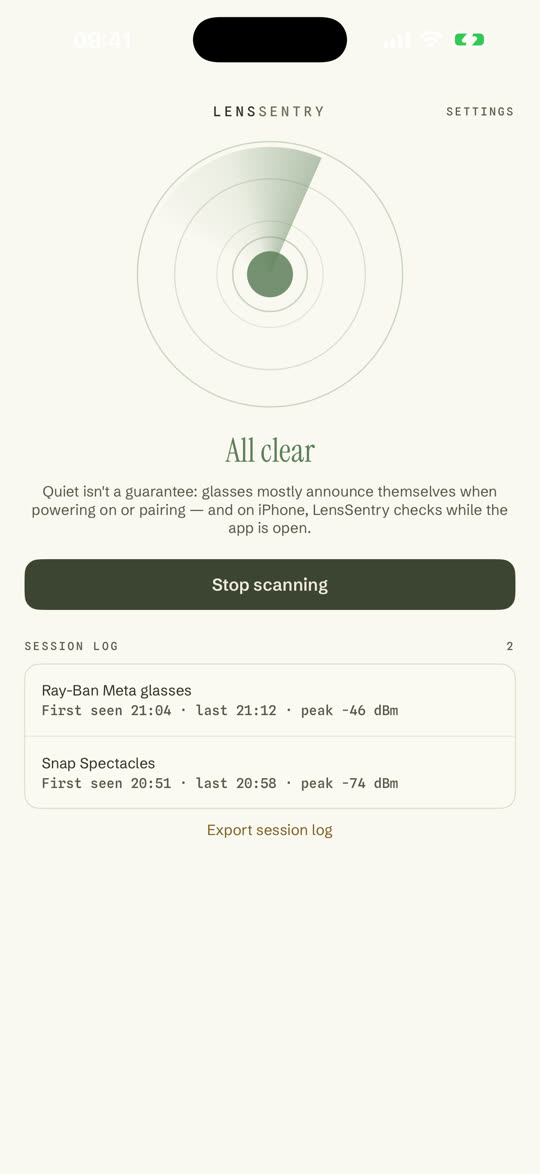
The all-clear state, and the sentence under it: quiet isn't a guarantee. Full-resolution screenshots and product frames available on request.
The essentials.
| What it is | A smart-glasses detection app: it listens for the Bluetooth Low Energy signals camera glasses broadcast (Ray-Ban Meta, Oakley Meta, Snap Spectacles, Amazon Echo Frames) and alerts the user that one may be nearby. |
| What's different | Honesty in both directions — the app states that a quiet screen isn't a guarantee and that an alert isn't proof of recording — plus over-the-air signature updates, a session log, and a camera-verify layer in development so every alert gets a next step. |
| Detection basis | Manufacturer identifiers and service UUIDs verified against the Bluetooth SIG registry and public field captures; name-pattern matching; confidence-tiered alerts. Known-lookalike devices (e.g. VR headsets sharing manufacturer IDs) are explicitly excluded. |
| Privacy posture | No location (never-for-location scanning), no accounts, no ads, no analytics, fully functional offline. Optional crowdsourced fingerprints are off by default and contain no hardware addresses, no location, and nothing about the reporter. |
| Status | iOS: live on the App Store ($2.99), United States at launch — apps.apple.com/us/app/lenssentry/id6801921114. On 15 August 2026 the app was confirmed detecting real camera glasses in the field on an iPhone — powered on and unpaired, matched at the highest confidence tier. Android: closed test opening shortly. macOS: an early build is downloadable from lenssentry.com, signed and notarized by Apple; it shares the same detection engine but its own scanner has not itself been confirmed against real glasses. Venue pilot program: accepting inquiries. |
| Pricing | $2.99, a one-time purchase. No subscription, no ads, no in-app purchases. Priced only after the detection engine was confirmed against real smart glasses in the field on 15 August 2026; charging for a detector before that would have contradicted the product. Over-the-air signature updates are included and will not become a paid tier — a detection library that goes stale unless you pay produces a quieter screen rather than an honest one. |
| Founder | Independent developer; based in Hawaiʻi. Full founder story available on request. |
| Contact | press@lenssentry.com |
Stories we can
speak to.
The detection arms race
Manufacturers can change their Bluetooth fingerprints at any time. Why detection has to be a living, updating system — and what that says about the power balance between platforms and the public.
Honesty as product design
Most detectors hedge their alerts but let a quiet screen imply safety. Why a privacy tool that overstates its own power is part of the problem.
Venues in the middle
Pubs and theatres are banning glasses they can't actually spot. What enforcement tooling looks like when it's built to inform staff, not surveil guests.